Winning a government contract is a different ballgame. It is a formal process where businesses compete to supply goods and services to government agencies. This structured competition is designed to ensure fairness and deliver the best value for public money. For the winning company, it often means securing long-term, stable revenue and a significant boost to your business's credibility.
Understanding the Landscape of Government Contracting
Breaking into government contracting can be a monumental achievement for any company, especially one in a specialized field like amphibious heavy machinery or environmental dredging. It is more than just another sale. It brings stability, builds prestige, and offers a chance to work on high-impact projects that shape our infrastructure and environment.
However, from the outside, the entire process can look like a maze. It often seems complicated, bureaucratic, and difficult to navigate.
This guide is designed to pull back the curtain and provide a clear roadmap, taking you from the first step of registration all the way to submitting a winning bid. With the right strategy and a solid understanding of how the system works, your company can effectively compete for and win these valuable contracts.
How Big is the Opportunity?
The government is the single largest buyer of goods and services in the world. This creates a massive market for businesses of all sizes, from small enterprises to large corporations.
Public procurement on a global scale is a huge driver of national economies, making up roughly 13% to 20% of GDP in many countries. In the United States alone, the government awards around $1.8 trillion in contracts every single year. These figures help explain why the bidding process is so competitive and why the regulations are so strict.
This level of spending translates to a constant demand for a wide range of services and equipment, particularly in sectors that require specialized solutions:
- Environmental Remediation: Projects like wetland restoration or contaminated site cleanup often require specialized amphibious excavators that can operate in sensitive environments.
- Infrastructure Development: Contracts for major projects like dredging waterways, building levees, and land reclamation all depend on heavy-duty, reliable machinery.
- Disaster Response: During emergencies, contracts for debris removal and flood mitigation are issued quickly, and amphibious equipment is often critical for accessing difficult terrain.
A Strategic Pursuit, Not Just a Sale
Engaging in government contracting is a strategic business decision, not just another sales channel. Unlike typical B2B transactions, the entire process is governed by strict regulations designed to ensure transparency, fairness, and accountability. Every step is documented, and every award decision is based on clear, pre-defined evaluation criteria.
A common myth is that government contracts automatically go to the lowest bidder. In reality, agencies are often looking for the "best value," which means they weigh a bidder’s technical capabilities, past performance, and project management plan alongside price.
This is excellent news for companies that offer superior quality and specialized solutions, like Wilco Manufacturing. You can compete effectively even if your price is not the absolute lowest.
Your advantage lies in demonstrating exactly how your amphibious equipment solves a specific agency's problem. The key is to highlight your expertise and prove your reliability in your proposal. That is what will set you apart. By staying informed about government needs and industry trends, you gain a real advantage. With the right preparation, this seemingly complex system becomes much more accessible, opening the door to projects that can define your company's future.
Getting Your Business Government-Ready
Before you can submit your first bid, you need to prepare your business. This involves more than just filling out forms. It is about laying a solid foundation that makes your business visible, credible, and eligible in the eyes of government procurement officers. This essential preparation separates serious contenders from the rest.
Think of it as strategically positioning your company to meet strict federal requirements and stand out in a crowded field. For companies with specialized offerings, like heavy equipment manufacturing or environmental remediation, getting these details right from the start is non-negotiable.
Securing Your Place in the System
Your journey begins at the government's central hub for contractors, the System for Award Management, better known as SAM.gov. Registration here is mandatory.
This process will assign your business a Unique Entity ID (UEI), which is the official identifier you will use across all federal awards. It is essentially your business's social security number for government contracting.
At the same time, you will select your North American Industry Classification System (NAICS) codes. These six-digit codes are more than a formality. They classify your business activities and are precisely what contracting officers use to find qualified vendors. For a company like Wilco Manufacturing, for example, the right codes are critical:
- 333120 Construction Machinery Manufacturing
- 562910 Remediation Services
- 237990 Other Heavy and Civil Engineering Construction
If you select the wrong codes, you will be invisible for the opportunities you are best equipped to win.
To give you a clear roadmap, here is a look at the essential credentials you will need to get started.
| Credential | Purpose | Governing Body/Website |
|---|---|---|
| Unique Entity ID (UEI) | The official, unique identifier for your business in federal systems. | SAM.gov |
| NAICS Codes | Classifies your business's products and services for procurement searches. | U.S. Census Bureau / SAM.gov |
| CAGE Code | A five-character ID for businesses doing work with the federal government. | Defense Logistics Agency (DLA) |
| Small Business Certifications | Provides access to set-aside contracts for specific business types. | Small Business Administration (SBA) |
Having these registrations in place is the bare minimum to be considered a legitimate government contractor.
Gaining a Competitive Edge with Certifications
While basic registration gets you in the door, small business certifications can give you a powerful advantage. The federal government has annual goals to award a certain percentage of all contract dollars to specific types of small businesses.
Securing a certification does not guarantee you a contract, but it opens doors to opportunities that are "set-aside" specifically for businesses like yours, dramatically reducing your competition.
Some of the most valuable federal certifications to explore include:
- 8(a) Business Development: For small, disadvantaged businesses.
- HUBZone: For businesses located in Historically Underutilized Business Zones.
- Woman-Owned Small Business (WOSB): For businesses primarily owned and run by women.
- Service-Disabled Veteran-Owned Small Business (SDVOSB): For businesses owned by service-disabled veterans.
The application process for these can be rigorous, but the payoff is significant, access to a less crowded marketplace where your unique status becomes a major asset.
Crafting a Powerful Capabilities Statement
Think of your capabilities statement as a one-page resume for your entire company, designed specifically for government agencies. It is often your first impression, so it must be sharp, concise, and compelling. It needs to tell a procurement officer exactly who you are, what you do, and why they should care in about 30 seconds.
A rock-solid capabilities statement must include:
- Core Competencies: A bulleted list of your key services. Be specific. Instead of "construction services," use phrases like "amphibious excavator rentals for wetland dredging" or "hydraulic undercarriage manufacturing for specialized heavy equipment."
- Past Performance: This is where you build trust. Highlight successful projects, especially any with government or large commercial clients. Mentioning a successful FEMA debris removal project or a state-level environmental cleanup contract provides instant credibility.
- Differentiators: What makes you the clear choice? Is it your patented technology, decades of industry experience, or a unique fleet of specialized equipment? This is where you connect your unique value to an agency's specific needs. We explain more about what sets us apart and the history behind our expertise in the detailed overview of Wilco Manufacturing.
- Company Data: Make it easy for them. Clearly list your UEI, CAGE code, NAICS codes, and any certifications you hold.
Finally, if your work involves any data or IT services, be prepared to demonstrate that your security is adequate. Many government contracts have strict information security requirements. You can explore information security policy templates to ensure your internal protocols meet federal standards, strengthening your overall bid-readiness.
Finding and Qualifying the Right Opportunities
Now that you are set up and government-ready, the real hunt begins. Success in government contracting is not about bidding on every opportunity. That is a fast track to burnout. The secret is developing a sharp eye for opportunities where you have a genuine, defensible chance to win.
You have to learn how to spot solicitations that are a perfect match for your company's core competencies. If you specialize in amphibious equipment, for instance, this goes beyond a simple keyword search. It means digging into the technical specifics of a project to determine if your machinery is truly the best solution for the job.
Mastering the Search on SAM.gov
The official hub for all federal opportunities is the System for Award Management, or SAM.gov. The interface can be overwhelming at first, but learning to use its advanced search filters is non-negotiable. Do not just type in broad terms like "dredging" or "construction."
You need to be surgical with your search to pinpoint the right contracts. Here is how successful contractors do it:
- Filter by NAICS Code: Remember those specific codes from your registration? Use them. A code like 237990 (Other Heavy and Civil Engineering Construction) will immediately cut out the noise and show you only relevant projects.
- Filter by Agency: Start targeting the agencies that are your most likely customers. Think about who needs your expertise. Groups like the U.S. Army Corps of Engineers (USACE), FEMA, or the Bureau of Land Management are often prime targets for amphibious equipment providers.
- Use Set-Aside Codes: This is a big one. If you have any small business certifications (like SDVOSB or HUBZone), filter for those "set-aside" opportunities. You are no longer competing against everyone. You are in a much smaller, more specialized pool.
While federal work gets most of the attention, do not overlook state and local opportunities. If you need a solid primer on where to look beyond the federal level, this guide on How to Find Contract Work is a great resource. The state, local, and education (SLED) market is huge, with projections showing it is expected to stabilize around 459,000 bids by 2026.
The Go/No-Go Decision Framework
You have found a promising opportunity. Now what? This next part is critical. You must have a disciplined "go/no-go" decision process. Think of it as a gatekeeper that forces you to be brutally honest about your chances before you invest a single minute into writing a proposal.
Before your team commits, you need a firm "yes" to every one of these questions:
- Do We Meet ALL Mandatory Requirements? There is no gray area here. If an RFP demands ten years of experience and you have nine and a half, you are out. Government contracting is a game of absolutes, and you will be disqualified.
- Is the Scope of Work a Perfect Fit? Does this project align perfectly with your core skills? A USACE project to restore a wetland by removing silt is an ideal fit for a company with specialized equipment for dredging that minimizes environmental impact.
- Do We Have a Winning Strategy? Can you explain precisely why you are the best choice? This could be your unique technology, a seasoned team, or an innovative approach that delivers superior value.
- Do We Have the Resources to Perform? Look at your current workload, your team’s availability, and your finances. Can you realistically take this on and deliver exceptional results without compromising other commitments?
- Is the Opportunity Profitable and Strategic? It is not just about the money. The contract has to make sense for your bottom line and your long-term goals. Sometimes, a smaller, strategic win that gets your foot in the door is far more valuable than a huge, low-margin project.
This framework is your defense against chasing bad-fit contracts. It will save you an incredible amount of time and money. Once you decide to pursue an opportunity and submit your bid, the agency’s evaluation process is fairly linear, as you can see below.
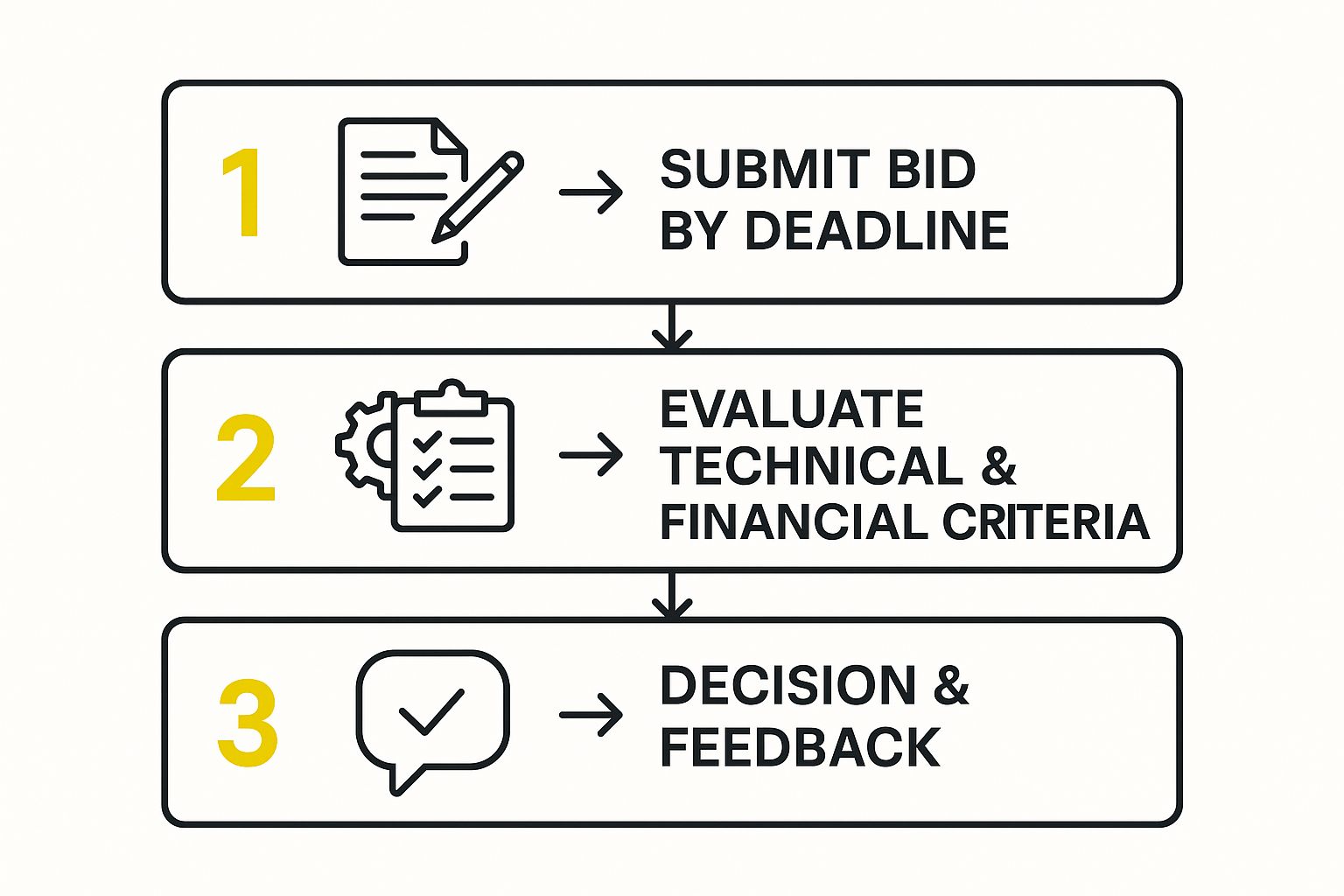
That is why nailing your own internal review is so vital. You have to pass your own test before you can even think about passing theirs.
By combining smart search tactics with a rigorous internal review, you stop gambling and start playing a strategic game. This focused approach means that when you finally decide to bid, you are not just hoping for the best. You are going in with clear-eyed confidence and a real plan to win.
Writing a Proposal That Wins
You have found the perfect opportunity. Now comes the real work: writing the proposal. This is where many companies stumble. A government proposal is not a marketing brochure. It is a technical, legal document where compliance is everything. Miss one signature or overlook a single requirement, and your bid could be dismissed before anyone reads your solution.
Your proposal has to prove, with cold, hard evidence, that your company is the safest and most capable choice for the taxpayer's dollar. If you have specialized machinery, this is your moment to shine. You need to show precisely how your equipment meets and exceeds what the project demands.
Dissecting the Request for Proposal
The Request for Proposal (RFP) is your bible for this project. Do not skim it. Read every single line, and then read it again. Trying to cut corners or make assumptions here is the quickest path to disqualification.
A smart move is to structure your proposal to mirror the RFP exactly. This makes life easy for the contracting officer, allowing them to literally check off their requirements as they read your response.
Pay special attention to these sections:
- Statement of Work (SOW): This outlines the specific tasks and deliverables. Your job is to respond to every point directly, explaining how you will accomplish it. For example, detail the exact process your team will use to clear a pipeline right-of-way in a marshy area.
- Technical Specifications: The details here are non-negotiable. If the RFP calls for equipment that can work in three feet of water with minimal ground disturbance, you need to state explicitly how your amphibious excavator meets that need. Back it up with data sheets, performance stats, and operational plans.
- Evaluation Criteria: This is gold. The government is telling you exactly how they will score your proposal. If the technical approach is weighted heavily, that is where you should focus your energy.
Crafting a Compelling and Compliant Response
Compliance gets your foot in the door, but a compelling story wins the contract. You need to connect the dots for the evaluator. Do not just show them that you meet the requirements. Show them why your solution is the best one available.
A winning proposal is built on a few key pillars. First, your technical approach needs to be crystal clear and detailed. Lay out your project management plan, your quality control measures, and the specific equipment you will use. For instance, if the project is dredging a sensitive wetland, describe how your specific machinery minimizes turbidity and protects the ecosystem.
Second, your past performance is your proof. Do not just include a list of old contracts.
Tell a story for each relevant project. Frame it with the initial challenge, the actions your team took, and the successful outcome. Quantify everything you can. "Completed the project 15% ahead of schedule" or "removed 5,000 cubic yards of silt without a single environmental incident" is far more powerful than just saying "we did a good job."
Finally, back up every single claim. If you say your equipment has the lowest ground pressure in its class, attach the spec sheet that proves it. Evidence is what turns a proposal from a list of promises into an undeniable argument that you are the right choice.
Developing a Smart Pricing Strategy
Price is always part of the equation, but the lowest bidder does not automatically win. Government agencies are almost always looking for the best value, which is a careful balance of technical skill and cost. Your pricing has to be competitive, but more importantly, it needs to be realistic and justifiable.
Your pricing section should be completely transparent. Break down your costs so they can see exactly what they are paying for:
- Labor Costs: Detail the roles, hours, and rates for every person on the project.
- Equipment Costs: List each piece of machinery and its associated operational or rental cost.
- Material and Supply Costs: Itemize every single thing you will need to buy.
- Overhead and Profit: Make sure these are reasonable and in line with government and industry standards.
A classic mistake is to lowball a bid just to win, only to realize you cannot actually perform the work for that price. That is a fast way to ruin your reputation and lose out on future contracts. Your price should reflect the true cost of delivering the high-quality work you promised in your technical section. A well-justified price, when paired with a superior technical solution, is an incredibly powerful combination.
Navigating Submission and Post-Award Debriefs
Hitting the "submit" button feels like the finish line, but in government contracting, it is really just the start of the final lap. This is where your patience and professionalism are tested. How you handle this last phase, from the moment you submit to the final award, can impact not just this bid, but your reputation for future opportunities.
Once your proposal is submitted, it enters a formal evaluation period. The contracting officer and their team will now review every detail. Your job is simple: be ready to respond, but do not be a pest.
The Submission and Clarification Dance
The final technical step is uploading your proposal to the designated portal. Do not leave this to the last minute. Servers can crash, files can get corrupted, and deadlines can be missed over simple tech glitches. Always aim to submit your proposal a full 24 to 48 hours early. That buffer is your best friend.
Now, do not be surprised if you receive a "Request for Clarification" from the contracting officer after you submit. This is often a great sign. It means they are taking your proposal seriously and just need you to clarify a specific point before they can move forward.
When you get one of these requests, remember a few key things:
- Act Fast: Acknowledge the request immediately and provide a clear, professional answer as quickly as possible.
- Stick to the Script: This is not your chance to add more marketing material or change your offer. Answer only the exact question they asked.
- Stay Consistent: Make sure your clarification perfectly matches your original proposal. Any contradiction is a major red flag for the evaluation team.
Think of a clarification request as an opportunity to prove you are the right partner. A prompt, precise, and professional response shows you are organized and easy to work with, qualities every contracting officer is looking for.
Nailing this part of the process reinforces all the hard work you have already put in.
The Debrief: Your Most Powerful Learning Tool
Win or lose, the process is not over until you have had a debriefing. This is, without a doubt, one of the most valuable learning moments in the entire bidding cycle, yet many companies skip it, especially after a loss. Do not make that mistake.
A debrief is simply a feedback session with the agency where they explain why you did or did not win. You should request one every single time, no matter the outcome.
If you won, the debrief will tell you exactly what they loved about your proposal. That is your winning formula which you can now replicate. But if you lost, the debrief is even more critical. You will get direct feedback on:
- Where you fell short: Was your technical approach confusing? Did your pricing seem unjustified?
- Why the winner won: The agency can explain what made the winning bid stand out (without giving away any trade secrets).
- What they misunderstood: You might discover that evaluators misinterpreted a key part of your offer, which tells you exactly what to write more clearly next time.
This is pure gold. You are getting an actionable roadmap from the source on how to improve. A loss becomes a strategic investment, arming you with the intelligence needed to come back stronger on the next bid.
This entire process is constantly evolving, with new tools changing the game. For example, AI-powered platforms can now scan thousands of solicitations to find the perfect match for a company's capabilities. You can find more insights on this at Procurement Sciences AI.
Common Questions About the Government Bidding Process
Stepping into the world of government contracts can feel like learning a new language. It is natural to have questions as you find your footing. Getting clear, straightforward answers is the best way to build confidence and focus your energy where it matters most, on crafting a proposal that stands out.
Let's walk through some of the most common questions we hear from businesses just like yours.
How Long Does the Bidding Process Take?
This is probably the number one question on everyone's mind, and the honest answer is, it depends. The timeline for a government bid can vary wildly based on the complexity and value of the contract.
For a simple, off-the-shelf purchase, you might see an award in just a few weeks. But for a major, multi-year project, like large-scale construction or highly specialized services, you could be looking at a process that takes six months to over a year. Factors like multi-agency reviews, security clearance checks, or even bid protests from competitors can significantly extend the timeline. Patience is not just a virtue here. It is a core business strategy.
Why Do So Many First-Time Bids Get Rejected?
It is a frustrating experience for newcomers, but the top reason for rejection is often painfully simple: non-compliance. It usually has nothing to do with the quality of your product or the competitiveness of your pricing. It almost always comes down to not following the solicitation's instructions to the letter.
A single missing form, the wrong document format, or failing to answer one small sub-point in the Statement of Work can get your entire proposal disqualified before it is even seriously reviewed. Government evaluators operate by the book, and for them, compliance is black and white.
Do I Really Need to Hire a Consultant to Win?
This is a strategic call, not a hard-and-fast rule. Many businesses, especially smaller ones, win contracts entirely on their own. The key is to be methodical and take full advantage of the excellent free resources available, like the training and one-on-one counseling from the Small Business Administration (SBA) and local APEX Accelerators (formerly known as PTACs).
So, when does a consultant make sense? They can be a valuable investment if you are pursuing a highly complex, multi-million dollar contract and feel out of your depth. A good consultant can help you avoid common pitfalls and shorten the learning curve, but they are not a substitute for a solid business and a well-crafted proposal.
How Can I Compete if I Don't Have "Past Performance"?
This is a classic chicken-and-egg problem. Past performance is a huge factor, it is often one of the most heavily weighted criteria in an evaluation. Government agencies want to minimize risk, and the best way to do that is to see proof that you have delivered successfully before.
If your company is new to the federal space, you have a few smart options:
- Highlight your team's experience: Focus on the relevant project histories of your key personnel.
- Showcase subcontracting work: If you have worked as a subcontractor for a prime contractor, that experience absolutely counts.
- Start small: Pursuing smaller contracts is a fantastic, proven strategy for building a solid track record. Each win becomes the past performance you need to land the next, bigger contract.
Navigating these challenges requires expertise and the right equipment for the job. Wilco Manufacturing has over a century of combined experience delivering reliable amphibious equipment for complex projects worldwide. From dredging and pipeline installation to environmental cleanup, our machinery provides the solutions decision-makers need. Contact us today to learn how our equipment can support your next project. Learn more about our solutions at https://wilcomfg.com.